C-SCRM for Retail: Cyber Supply Chain Risk Guide

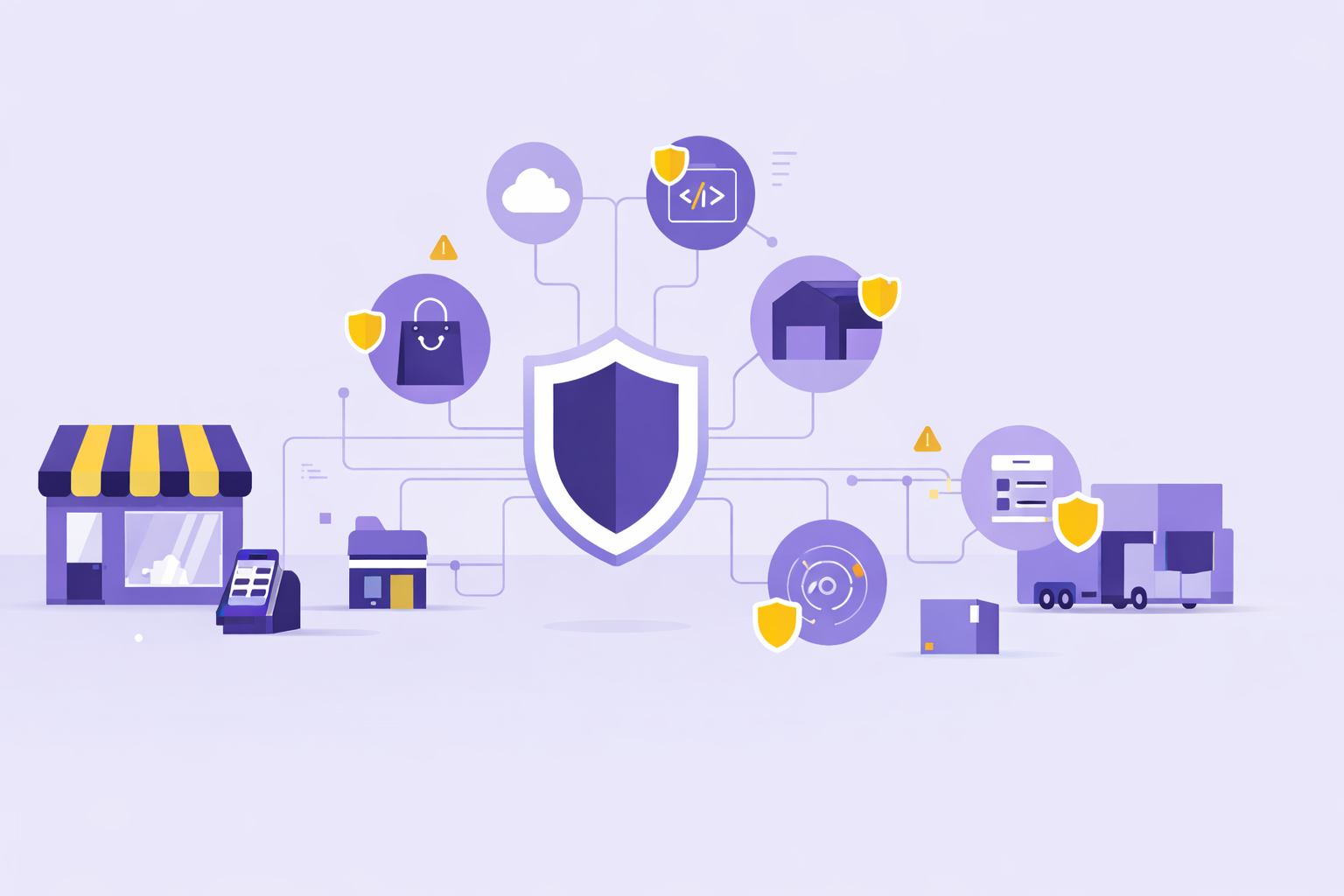
C-SCRM: Cyber Supply Chain Risk Management in the Retail Industry
Retail security doesn’t fail in one place, it fails at the seams.
If you’re a Retail CISO at a midmarket or SMB brand, you’re juggling POS systems, ecommerce platforms, payment processors, logistics partners, marketing tags, SaaS tools, MSPs, and countless integrations that keep revenue moving. Each of those vendors expands your attack surface. That’s why C-scrm (Cyber Supply Chain Risk Management) is now a core part of modern retail cybersecurity, not a “nice to have.”
This guide breaks down how to implement C-SCRM in retail in a practical way: how to map your vendor ecosystem, tier risk, assess vendor cybersecurity, tighten contracts, continuously monitor, and coordinate incident response plus a checklist and a 30-day starter plan.
Explore retail cybersecurity solutions, and protect your business today!
Learn more about Jericho Security’s retail cybersecurity solutions.
Table of contents
- What is C-SCRM (and why retail needs it)?
- C-SCRM vs. third-party risk management (TPRM): what’s different?
- Why supply chain cybersecurity matters for retailers
- The retail supply chain threat model (what actually goes wrong)
- Step-by-step: a practical C-SCRM program for midmarket retail
- Retail C-SCRM Checklist
- Common pitfalls (and how to avoid them)
- How to get started in 30 days (week-by-week)
- How Jericho Security can help (placeholders)
- FAQ: People Also Ask
- Optional: FAQ schema (JSON-LD)
What is cyber supply chain risk management (C-SCRM) in retail?
C-SCRM is the discipline of identifying, assessing, and reducing cybersecurity risk that comes from the vendors, service providers, software, hardware, and dependencies your business relies on. In retail, that “supply chain” includes everything from cloud hosting and ecommerce apps to POS providers, call centers, and fulfillment partners.
A good C-SCRM program focuses on three outcomes:
- Confidentiality: customer data, employee data, and sensitive business data stay protected.
- Integrity: your systems and transactions aren’t tampered with.
- Availability: you can keep selling - online and in-store - without costly downtime.
C-SCRM vs. third-party risk management (TPRM): what’s different?
Traditional third-party risk management often stops at onboarding: a questionnaire, a SOC 2 review, maybe a contract clause, and then it’s filed away.
C-SCRM goes further. It’s designed for real-world dependency risk:
- Sub-tier dependencies: your vendor’s vendor matters (and often causes the incident).
- Operational resilience: retail can’t pause operations during peak season.
- Access + integration sprawl: APIs, plugins, and data-sharing multiply quickly.
- Continuous change: vendors ship updates weekly; risk changes weekly too.
Think of C-SCRM as TPRM plus: dependency mapping, tiering, continuous monitoring, and incident coordination, built for fast-moving supply chains.
Why supply chain cybersecurity is uniquely important for retailers
Retailers are high-value targets because attackers can monetize disruption fast:
- Payments and fraud: credit card data, account takeovers, gift card fraud, and refund abuse.
- Customer data concentration: loyalty programs and customer profiles are goldmines.
- Always-on operations: downtime means immediate revenue loss and reputational damage.
- Seasonal surges: “busy” is when controls get bypassed and vendors get rushed in.
For midmarket or SMB retail, the challenge is even sharper: smaller teams, limited budget, and vendor sprawl that grows faster than governance.
The retail supply chain threat model: common third-party cyber risks
Here’s what frequently breaks in real retail environments (and where to focus your C-SCRM program):
1) Vendor compromise → privileged access abuse
If a vendor is compromised (MSP, software provider, support contractor), attackers may inherit admin access into your environment.
Retail examples: MSP remote tools, support portals, POS maintenance accounts, SSO-integrated SaaS apps.
2) API and integration risk
Modern retail runs on integrations: ecommerce to ERP, marketplace to inventory, marketing to customer data. Poorly secured APIs can expose data or enable fraud.
Retail examples: marketplace connectors, affiliate/marketing tags, shipping and fulfillment APIs.
3) Software supply chain risk
A compromised update, library, or plugin can introduce malicious code into production—especially in ecommerce ecosystems.
Retail examples: ecommerce plugins, analytics scripts, web SDKs, mobile app dependencies.
4) Data sharing and overexposure
Vendors often receive more data than necessary. Overexposure creates breach blast radius.
Retail examples: loyalty data sent to marketing tools, customer data passed to customer support vendors.
5) Fourth-party risk (subprocessors)
Your vendor outsources part of its service. You may never see those dependencies unless you ask.
Retail examples: call centers, payment components, hosting providers, offshore support.
At-a-glance: what to do first
If you do nothing else this month:
- Inventory vendors + integrations (who touches what)
- Tier vendors by business impact + access
- Standardize evidence-based assessments for top-tier vendors
- Update contract clauses for the vendors that matter most
- Schedule a quarterly reassessment cadence + incident coordination drill
Step-by-step: a practical C-SCRM program for midmarket retail
Step 1: Map your vendor ecosystem (inventory + data flows)
Start with a single list. Keep it lightweight, but complete.
Capture for each vendor:
- What service they provide
- Data they access (customer PII, payments, employee data, analytics)
- Level of access (admin, read-only, API token, VPN, SSO)
- Where they connect (POS, ecommerce, IAM/SSO, endpoint tools, finance)
- Whether they use subprocessors
- Contract renewal date + owner internally
Tip: Don’t chase perfection. Start with “top 30 vendors,” then expand.
Step 2: Tier vendors by criticality (impact + privilege)
A workable tiering model for retail:
Tier 1 (Critical):
Could cause major revenue loss, customer harm, or widespread compromise if breached.
Examples: payment-related systems, POS vendor, ecommerce platform, IAM/SSO provider, MSP with admin access, key logistics/fulfillment integration.Tier 2 (Important):
Handles sensitive data or meaningful access, but not existential.
Examples: customer support platform, marketing automation with customer data, HR/payroll.Tier 3 (Standard):
Minimal access and low impact.
Examples: tools with no PII, low-privilege utilities.Tiering helps you allocate effort: deep assessment for Tier 1, lighter controls for Tier 2, and minimal overhead for Tier 3.
Step 3: Assess vendor cybersecurity risk (evidence-based, not checkbox-based)
For Tier 1 vendors, you want proof, not promises.
Focus your assessment on:
A) Access security
- MFA enforcement (especially for admin roles)
- Role-based access controls
- SSO support and logging
B) Data protection
- Encryption in transit and at rest
- Data retention and deletion practices
- Segmentation and tenant isolation (if SaaS)
C) Vulnerability management
- Patch cadence
- Secure SDLC practices
- Pen test cadence and scope
D) Monitoring and detection
- Centralized logging
- Alerting and incident detection process
- Ability to support forensic investigation
E) Incident response
- Breach notification timelines
- Communication plan and escalation path
- Lessons learned / post-incident remediation
F) Business continuity
- Backups and recovery testing
- RTO/RPO (especially for revenue-critical systems)
- Peak season resilience planning
What to collect (quick evidence pack):
- SOC 2 Type II or ISO 27001 certificate (if available)
- Security policy summary (acceptable use, access control)
- Pen test executive summary (recent)
- Incident response overview (process + SLA)
- Subprocessor list
If a vendor can’t provide evidence, that’s not an automatic “no” but it is a signal to reduce exposure (limit access, minimize data, add monitoring, or require remediation).
Step 4: Build security requirements into contracts (and make them enforceable)
Contract language is one of the most underused security controls in midmarket retail.
Minimum contract/security addendum components for Tier 1 vendors:
- Breach notification window (clear timeframe)
- Right to audit / security attestations (annual evidence)
- Subprocessor disclosure and change notification
- Access controls (MFA, least privilege, logging)
- Data handling (retention, deletion, location, encryption)
- Incident cooperation clause (forensics support, timely comms)
- SLA language tied to availability and recovery expectations
Contracts won’t prevent incidents—but they reduce ambiguity and speed up containment when something happens.
Step 5: Continuous monitoring and reassessment cadence (keep it realistic)
C-SCRM fails when it becomes a once-a-year spreadsheet exercise.
A practical cadence:
- Tier 1: quarterly review (lightweight) + annual deeper reassessment
- Tier 2: semi-annual review + annual reassessment
- Tier 3: annual review or only on material change
Trigger reassessment when:
- Vendor adds new subprocessor
- You expand data sharing
- Vendor changes hosting/architecture
- You grant higher privileges
- Vendor experiences a security incident
Step 6: Vendor incident response coordination (the part most teams skip)
When the incident hits, you need speed, clarity, and access to the right people.
For Tier 1 vendors, pre-establish:
- 24/7 escalation contact
- Joint incident comms workflow
- Logging expectations and evidence preservation
- Playbook alignment (who does what, when)
Run a quick tabletop for one scenario per quarter (30–45 minutes). It’s the fastest way to reveal gaps before peak season.
Retail scenario example: POS vendor compromise
Scenario: A POS support vendor’s credentials are compromised, giving attackers remote access to multiple stores’ POS management interfaces.
What goes wrong without C-SCRM:
- The vendor had shared admin accounts and weak MFA
- You didn’t know which stores or systems were connected
- Contract didn’t specify rapid notification or forensic support
- You can’t quickly validate if customer payment data was impacted
What C-SCRM changes:
- Vendor tiering triggers stronger access controls and evidence requirements
- You limit privileges to store-specific roles
- You require MFA + logging + breach notification SLA
- You already have the incident coordination path defined
Retail C-SCRM Checklist
Use this as a quick internal audit to validate your program:
Vendor inventory
- I have a centralized vendor + integration inventory
- I know which vendors access customer data, payment data, or admin systems
- I track vendor owners internally and contract renewal dates
Vendor tiering
- I’ve tiered vendors by business impact + access level
- Tier 1 vendors are clearly defined (revenue, payment, IAM, MSP, ecommerce, POS)
Vendor cybersecurity assessment
- Tier 1 vendors provide evidence (SOC 2/ISO, pen test summary, IR process)
- I review vendor MFA, access controls, logging, and IR commitments
- I limit vendor data access to what’s necessary (data minimization)
Contract controls
- Contracts include breach notification timelines and incident cooperation
- Contracts include subprocessor disclosure and change notification
- Contracts include security requirements (MFA, least privilege, encryption)
Continuous monitoring
- Tier 1 vendors have a quarterly check-in cadence
- I reassess when access expands or architecture changes
- I maintain a simple “vendor change log”
Incident readiness
- I have an escalation path for Tier 1 vendors
- I’ve run at least one vendor tabletop exercise in the last 6–12 months
Want a faster path to practical retail risk reduction? Explore Jericho Security’s retail cybersecurity solutions (https://www.jerichosecurity.com/industries/retail)
Common pitfalls (and how to avoid them)
- Pitfall: Treating all vendors the same
Fix: Tier vendors and focus on the few that can truly hurt you. - Pitfall: Relying on questionnaires alone
Fix: Ask for evidence packs for Tier 1 vendors. - Pitfall: Forgetting fourth parties
Fix: Require subprocessor lists and change notifications. - Pitfall: Over-collecting vendor data
Fix: Minimize shared data and restrict access scopes. - Pitfall: No incident coordination plan
Fix: Pre-establish escalation contacts and run lightweight table tops. - Pitfall: “Annual review” becomes “never again”
Fix: Set a realistic cadence tied to business changes.
How to get started in 30 days (week-by-week)
Week 1: Inventory + quick tiering
- Identify your top 20–30 vendors and integrations
- Tag which ones touch customer data, payments, or admin access
- Create a preliminary Tier 1/2/3 list
Week 2: Evidence and access tightening for Tier 1
- Request Tier 1 evidence packs (SOC 2/ISO, pen test summary, IR process)
- Confirm MFA and logging expectations
- Reduce access where possible (least privilege, limit tokens, remove shared accounts)
Week 3: Contract upgrades + process standardization
- Standardize security addendum language for Tier 1 renewals
- Define breach notification expectations and incident cooperation requirements
- Build a one-page vendor assessment checklist your team can repeat
Week 4: Monitoring + incident readiness
- Schedule quarterly Tier 1 review meetings (even 20 minutes)
- Create a vendor escalation contact list
- Run a 30–45 minute tabletop for one Tier 1 vendor scenario
By day 30, you won’t have “perfect C-SCRM,” but you’ll have a defensible, repeatable foundation that reduces supply chain risk without overwhelming your team.
How Jericho Security can help CISOs
If you want to operationalize C-SCRM without building everything from scratch, Jericho Security can support retail teams with our multi-channel phishing capabilities to help you improve your security readiness.
Conclusion: C-SCRM is retail resilience
For retail CISOs, C-SCRM isn’t a compliance checkbox, it’s a resilience strategy. Your ability to keep stores open, keep e-commerce running, and protect customer trust depends on managing the security realities of your vendor ecosystem.
Start small: inventory, tiering, evidence-based assessments, contract controls, monitoring cadence, and vendor incident coordination. The payoff is fewer surprises, faster response, and reduced business risk especially when it matters most.
Explore retail cybersecurity solutions, and protect your business today! Explore Jericho Security’s retail cybersecurity solutions (https://www.jerichosecurity.com/industries/retail)
FAQ (People Also Ask)
What is cyber supply chain risk management (C-SCRM)?
C-SCRM is the process of identifying, assessing, and reducing cybersecurity risk from vendors, software, hardware, and dependencies your organization relies on.
Why is supply chain cybersecurity important for retailers?
Retailers depend on many third parties to run sales, payments, fulfillment, and customer experiences. A vendor incident can cause downtime, fraud, and reputational damage quickly.
What are common third-party cyber risks in retail?
Common risks include vendor credential compromise, insecure integrations/APIs, software supply chain compromise, excessive data sharing, and fourth-party (subprocessor) exposures.
How can retailers assess vendor cybersecurity risk?
Tier vendors by impact and access, then use evidence-based assessments for critical vendors (attestations, pen test summaries, IR process, access controls, logging, and continuity plans).
What frameworks support C-SCRM in retail?
Retailers often align with NIST frameworks (including supply chain guidance), ISO 27001, SOC 2 reports, and PCI DSS requirements where payment data is involved.